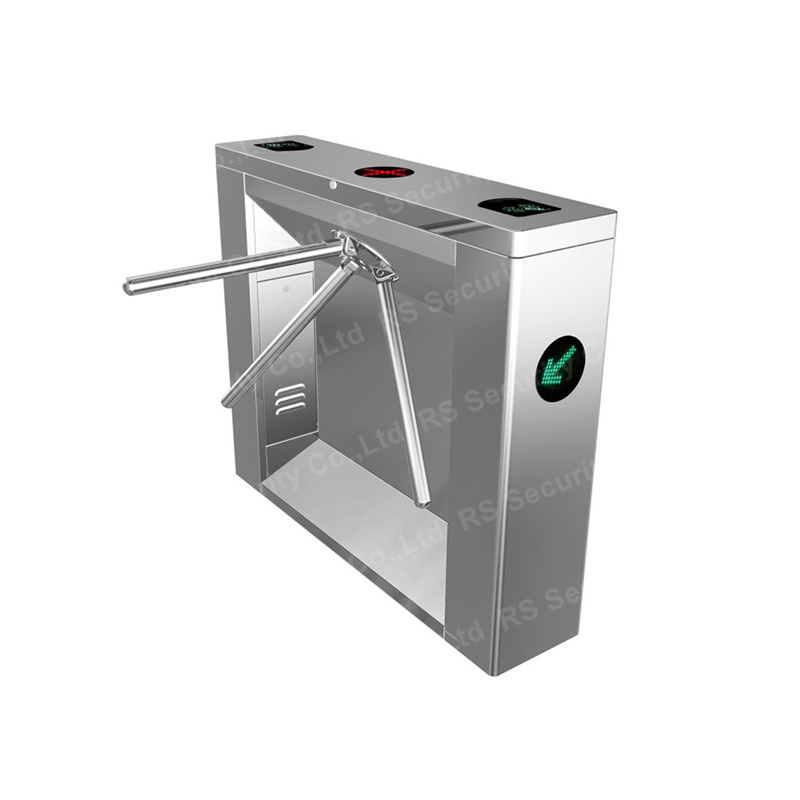
Semi-Automatic Right Angle Tripod Turnstile
Access Right Angle tripod turnstiles gate feature an anti-tailgating mechanism which automatically locks its blocking arm after rotating 120 degrees, effectively preventing tailgating and providing an efficient way of managing passage in high volume locations.
It features multiple working functions and is simple to operate and maintain, making it an excellent choice for construction sites, scenic spots and gyms.
Power supply
Power supplies of tripod turnstiles are essential components for their performance. If the power supply is neglected or mismanaged, it may fail prematurely or cause issues with the system – if this occurs it’s important to understand what these issues mean and how best to resolve them. Tripod turnstiles are an excellent choice for controlling access in various types of businesses as well as residential buildings and schools – however they can become susceptible to errors like slow response or insensitivity which make operation and maintenance challenging and can even become impossible at times.
The most widely-used tripod turnstile is the fully automatic model with an electric motor powering its entire operation, offering greater security and reliability compared to manual turnstiles. Due to its excellent anti-tailing effect, fully automated tripod turnstiles are suitable for places like five-star hotels, company headquarters, malls and clubs that need strict control of entry numbers.
A typical tripod turnstile gate is composed of three arms that form an effective barrier and can be rotated to permit or deny passage, making them suitable for offices, hospitals, banks and public libraries. They typically feature domestic 304 or 316 stainless steel arms which do not easily deform and offer great corrosion resistance – while its mechanism is powered by a brushless motor with switchable left and right normally open functions to simplify use.
Tripod turnstiles require less maintenance than other forms of turnstiles. They are more cost-effective, as they can be used for extended periods without incurring maintenance costs; their surfaces can even be coated with various finishes like powder coating, electroplating paint, or patterns to better match interior designs of buildings or facilities. Tripod turnstiles also stand up well under severe wear and tear; unlike their metal counterparts.
An indicator light not lighting on tripod turnstiles is a common issue, usually caused by power supply issues. To remedy this, first check that your circuit board is functioning as it should before adjusting your electromagnet screw so it lands below the pull-in gap. If that fails to resolve it, try lowering it until your indicator light illuminates again.
Motor drive
A semi-automatic Right Angle tripod turnstile’s motor drive is responsible for powering its movement. It consists of three complex devices – motor, reduction device and sensor device. Of these components, motor play an essential role in smooth and safe turnstile operation while reduction devices help decrease its speed to increase effectiveness and reliability of mechanism operation. Finally, sensor devices detect when turnstile is in motion or has received an open signal from an access control system.
A tripod turnstile employs a mechanical anti-tailgating design to ensure only one person at a time can pass through at once, and has specific transmission and locking systems to control entry and exit. Furthermore, its built-in display screen shows personnel their name or department name upon entry; all this makes the system extremely user-friendly while remaining highly efficient – plus you can integrate it easily with existing access control software!
Many components of a tripod turnstile are constructed from domestic 304 or 316 stainless steel, which is durable enough to withstand external forces without deforming easily or rusting quickly, making cleaning and maintenance much simpler. Regular cleaning, particularly after rainfall, should help ensure its surface doesn’t oxidize; applying a rust inhibitor may be helpful as well.
Tripod turnstiles come in both manual and automatic models, and can be configured with various types of access control hardware and software. You can add push to exit buttons with proximity readers, badge readers, biometric access systems or biometric facial recognition technology for biometric access control purposes. In addition to single or dual directional arm configuration options to suit your individual needs.
An anti-tailgating design is one of the key features of a semi-automatic Right Angle turnstile and an integral component of its security. Once receiving an open signal from its controller, this machine unlocks its blocking rods and releases its brake lever, spinning 120 degrees one way to allow users to enter passageway. If no valid open signal arrives within an acceptable amount of time, however, the turnstile will lock and shut itself automatically.
Reduction device
A tripod turnstile is a type of entrance gate that can be operated manually or automatically. Featuring mechanical anti-tailgating design and two electromagnets to limit access for only one person at once and its unique structure to block bicycles and pushchairs from passing, making this type of access control system perfect for busy office buildings, gyms, exhibition and convention centers, entrances as well as for entryways with minimal maintenance requirements.
A semi-automatic tripod turnstile uses a motor to drive its barrier and a reduction device to decrease its torque of rotation. This reduction unit typically features gears arranged symmetrically around its motor shaft; they reduce force required to rotate both barrier arm and brake lever, thus decreasing accidental activations risk while making operation more convenient for elderly individuals and children alike.
Tripod turnstile reduction devices comprise of a motor 6 that transmits its rotation to a series of gears – or in its preferred embodiment, to a reduction component 7 comprising of male cycloid gear and output ring gear 7a – known as output ring gear. The first reduction stage reduces rotational speed transmitted from motor to second and third stages by providing extra torque reduction from this first reduction stage.
As soon as a turnstile detects an admission signal, it disconnects a solenoid holding its barrier arms in their home positions – this allows them to rotate in either direction depending on what signal has been received by its passing system.
Once the barrier arms have been unlocked, a brake lever is released to allow a user to proceed forward. Once authorized by the control system, authorization may be cancelled in case a credential has been bumped or reversed or rejected if passage cannot be granted; this feature helps prevent unauthorised usage as well as emergency situations where lives need protecting.
Before purchasing a turnstile for your business needs, it’s essential that you consider all aspects of its design based on its requirements and select an ideal model. Factors to keep in mind include number of identification methods available, passage mode selection and safety requirements – selecting an optimal model will improve security while streamlining operations – make sure the manufacturer prioritizes customer service and offers superior products when buying this equipment.
Control device
Control Device of Right Angle tripod Turnstiles A semi-automatic Right Angle tripod turnstile is an intelligent mechanism designed to regulate how barrier arms are locked and unlocked, which makes this turnstile suitable for standalone installation or integration into other security solutions such as door access control systems, ticketing or biometric recognition. Featuring sturdy construction which withstands high traffic with ease of maintenance; connection with host computers ensures instant alarm signal responses; customisation options allow these turnstiles to provide additional layers of protection – not forgetting alarm displays for extra secure turnstiles!
Semi-automatic tripod turnstiles equipped with mechanical anti-tailgating design and two electromagnets ensure only one person at a time may pass. Once credentials have been verified, positioning arm of movement is released, brake lever pushed gently until rotating 120 degrees, and electromagnet unlocks passage through pushing on one direction of blocking rod blocking rod blocking rod blocking rod blocking rod blocking rod blocking rod blocking rod blocking rod blocking rod blocking rod blocking rod blocking rod blocking rod blocking rod blocking rod pushing through to allow user passage through passageway.
This turnstile features an automatic reset function which cancels passage authorization if no one passes within a specified amount of time, helping prevent fraud by only permitting authorized users into your facility. Furthermore, its mechanism can be set to operate one- or bi-directionally according to your organization’s needs.
In a fire or evacuation emergency, the locking arm of the barrier may be quickly moved from its normal position by activating a solenoid. This solenoid is activated via fire alarm or evacuation alarm and influences its spring-biased activation arm via pin in lockbridge of arm mechanism; its force causes barrier arm to shift downward into vertical evacuation position.
Upgrades can be made to the control board of a turnstile to support more advanced functions, including face detection systems that allow users to pass without needing to swipe their card, and connections with computers for visually impaired access. It is vital that these updates occur regularly to keep your turnstile operating efficiently while reducing maintenance costs and keeping security systems operating optimally.