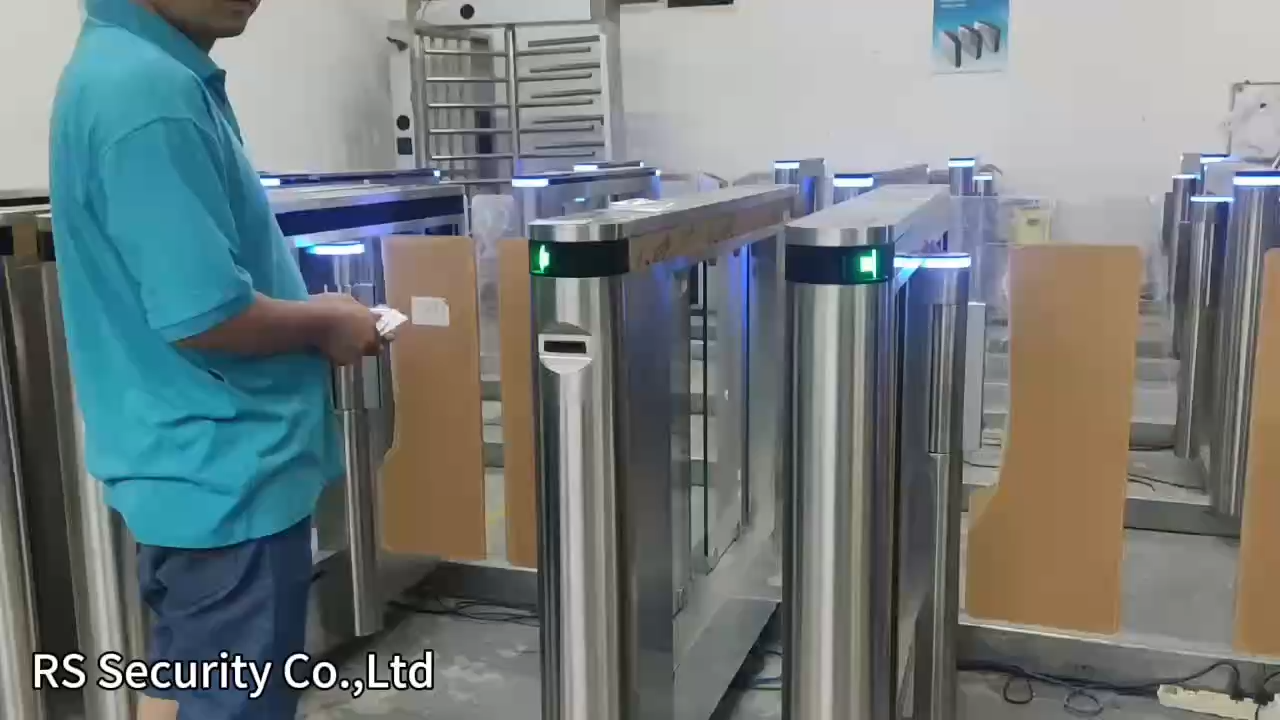
Column Rotating Swing Turnstile
Column rotating swing turnstiles feature high plasticity of appearance, making them popular choices in smart business buildings and high-end clubs. Operating it requires no mechanical collision and creates minimal noise levels – ideal for use in any environment!
As someone passes the turnstile from one of its home positions, their passage causes compression springs 20 to compress, thus storing potential energy within this torque-restoring mechanism 13. A damping effect is created through two pistons defining two cylinder cavities that creates two cylinder cavities – and these could potentially act as potential energy storage mechanisms as potential energy is released back into this torque-restoring mechanism .
Function
Column rotating swing turnstile gates provide pedestrian access control security turnstile gates that feature high-end aesthetics, firm structures, effortless deployment and operation; plus compatible with various door access management devices like face recognition apparatuses or fingerprint recognition apparatuses to accomplish door access control functions in various venues like smart buildings, government buildings, enterprise parks schools or clubs etc.
This type of turnstile can be divided into various classes depending on its environment and function, including free mode, controlled mode and forbidden mode – perfect for passage of personnel in subway turnstile gate systems and ticketing turnstile gate systems as well as entrances/exits of buildings/closed geographical areas where pedestrian flow needs to be managed safely and managed effectively.
Column rotating swing turnstiles utilize a driving motor situated along the central axis, with three locking arms offset by 120deg from one another. A bearing plate supports its rotor while two locking arms pivot back to their normal operating positions. Once powered up, this type of turnstile’s drives allow its locking arms to return to their usual operating positions by way of gravity. Resetting a folded-down locking arm back to its normal operating position can be particularly effective if, as is often the case for waist height turnstiles with three offset locking arms of 120deg from each other, when an event has concluded which caused one locking arm to move from its locking position into non-use, after this event has stopped, its articulation axis passes through a lower culmination point on its orbit on a bearing plate.
Cylindar speed turnstiles feature mechanical anti-pinch wings to prevent their being forced open by force, or when being pushed by hand; should an attempt at entry be made without authorization, the system will send out an alarm signal and stop.
Design
Column rotating swing turnstiles are intelligent turnstile gates designed with aesthetic appeal, easy deployment and longevity in mind. They can be easily integrated with various access control devices – such as face recognition temperature scanners and fingerprint readers – to fulfill door access control management functions and are widely used in public places such as government agencies, clubs & century, office buildings etc. to manage pedestrian flow effectively.
A column rotating swing turnstile is typically constructed out of stainless steel, plexiglass or toughened glass for its blocking body, with its surface being flexible to prevent pedestrians from walking into it and potentially hurting themselves. Some gates even use special flexible materials wrapped around metal plates in order to reduce injury during pushing operations.
Comparative to its flap barrier gate counterpart, a swing turnstile gate offers larger passage width and is easier to operate, making it better suited to people using wheelchairs, strollers or luggage carts. Furthermore, these turnstile gates can increase entrance lanes to improve traffic throughput while simultaneously detecting direction of passage with anti-reverse functionality enhancing security.
Turnstile gates include locking arms 14 that are connected to a bearing plate 16 by means of articulated axes that run at right angles to the axis of rotation of the turntile gate 13. When events that trigger mobility of these arms into non-use positions have ended, an electric indexing motor rotates the bearing plate 16 which activates its restoring forces on them and restores them back into normal operating positions.
The gate is powered by an AC motor fitted with a residual current protective device to avoid electrical shocks. It can be remotely controlled and connected with other read/write devices through a unified external interface for more effective system management, with its durable construction extending its lifespan for years.
Installation
A column rotating swing turnstile is a mechanical gate or barrier designed to allow one person to pass in either direction at a time, often used for crowd control or access control purposes. As an economical and space-efficient solution, these turnstiles make an ideal addition in areas with limited space – optimizing site utilization while also meeting Americans with Disabilities Act compliance standards within budgetary parameters.
Turnstile structures can be divided into single-channel and double-core swing barrier models. A single-channel turnstile consists of two separate single-core mechanisms working independently from each other while double-core models feature one dual mechanism working simultaneously but independently from one another. Both mechanisms feature central rotating columns with three locking arms configured either right or left handed for easy adaptation to different user needs.
This security turnstile can be equipped with various sensors to ensure maximum levels of safety and security, such as optical or RFID readers to detect the presence of unapproved individuals, audio speakers for public outreach messages, as well as panic buttons for fast evacuation in an emergency situation.
Comparative to flap barriers, swing gates provide wider passage width and can be fitted with special disabled passes for convenient use. Their attractive appearance and easy maintenance make them more popular; and their material options meet various application demands.
Bearing pins support the articulation of folding-away locking arms that support their articulation at right angles to the axis of rotation of the turnstile system 10. In this instance, with all other locking arms 14 absent from Figure 1, achieving a locked state is accomplished by resetting the turnstile system after an event which caused folding down of one arm into its non-use position has ceased and resetting it in this manner. Resetting is particularly safe because its articulation axis passes directly over its lower culmination point of orbit on bearing plate 16; therefore this reset ensures safe passage from being folded back out again by passing its articulation axis along its orbit path on bearing plate 16. This reset process works through its lower culmination point on bearing plate 16, providing maximum safety to everyone involved.
Maintenance
Pedestrian turnstile gates are widely utilized security systems and play an essential part. They offer reliable service with long lifespans; however, their longevity depends on how well they are maintained; preventive post-maintenance is the most efficient way to extend their lives according to manufacturer recommendations.
The chassis of a turnstile is typically polished stainless steel, so regular cleaning with a soft cloth to preserve its beautiful surface. Furthermore, beam window maintenance should also be conducted regularly to avoid dust accumulation and stains on it. Finally, port connection sockets should also be regularly tested for electricity to identify problems before using lubricants to lubricate mechanism components and regularly test operation of gate to ensure smooth connections.
To keep a full height turnstile gate in optimal condition, users should create and adhere to a regular maintenance schedule and follow manufacturer recommendations. This will reduce maintenance costs while preventing minor issues from snowballing into major ones and will increase reliability of the gate.
One of the most essential maintenance tasks is conducting regular checks on an entire turnstile every week, which should include opening up its cover and clearing away dust. Furthermore, wiping the internal transmission parts with corrosion-free cleaning solution and lint-free cloth as well as applying butter or high concentration oil can greatly help ensure optimal transmission gear functioning and maintenance needs. Furthermore, ensure proper gear gap spacing exists and clean out infrared acrylic mirror regularly is important as well.
Additionally, it is also advisable to perform an annual electrical check of the turnstile gate and replace any worn parts as necessary. As replacing electronic components requires technical expertise, it may be best to contact your turnstile gate supplier for assistance.